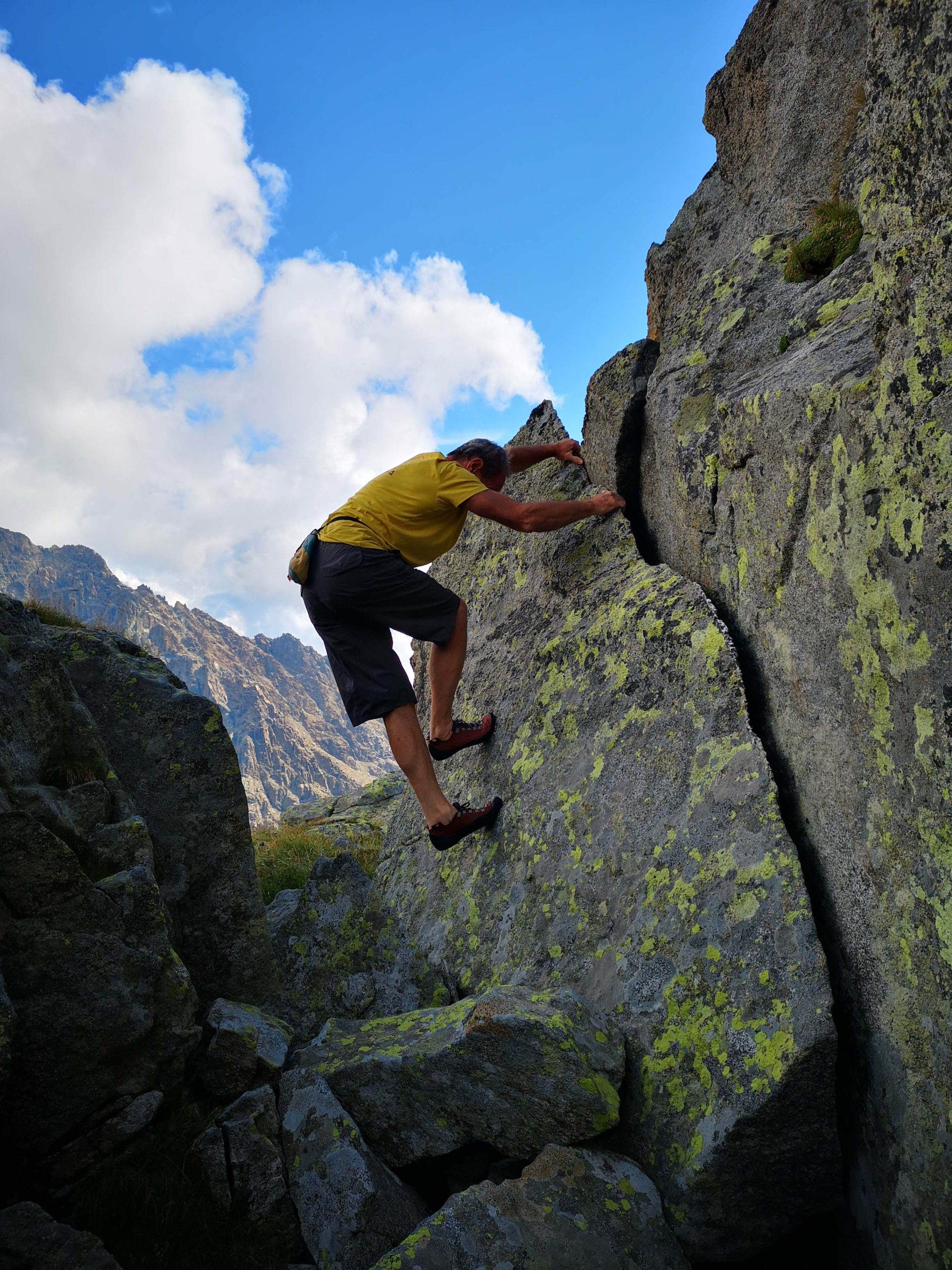
The Origins of the Method

How it all began
When I first started climbing, I immediately looked for someone who could teach me the art of rock climbing. Every sport has its own technique, and having practised many sports before, I naturally wondered what the underlying principles of this one might be.
To my surprise, all I could find were detailed explanations of knots and rope manoeuvres—along with a single piece of advice: get a lot of experience, and you’ll learn along the way. And so, I began to accumulate climbs.
A few years later, after becoming a Mountain Guide, the absence of real technical content to teach began to weigh heavily on me. How could I do my job if I was unable to explain the how and the why of movement on rock? Strangely enough, no one seemed to see this as a problem. In all the courses available at the time, instead of actually teaching rock climbing, students were simply taken climbing.
In the early 1990s, the Italian National Olympic Committee (CONI) organised the first official course for rock climbing instructors. The programme included many interesting subjects, yet none addressed movement technique. When I asked why, the answer was astonishing: technique was, of course, already known to us—the instructors and Mountain Guides attending the course! We were considered the experts in the field. The CONI trainers could teach us about training theory, psychology, and sports physiology—but certainly not about rock climbing technique. The truth, however, was that no one really knew anything about it. And yet, how could we be called instructors if we had nothing to teach?
The CONI trainers themselves openly acknowledged that, in practice, without technique there can be no sport. Even so, among the participants—some of whom were already competing—there were those who claimed that rock climbing technique did not exist, because climbing was an “instinctive” activity.
That was when I began to realise that an unexamined cultural belief had led people to consider rock climbing unteachable: partly because all children, in one way or another, “climb”; and partly because the terrain is constantly changing and the possible movements are infinite.
How, then, could there ever be a rule?
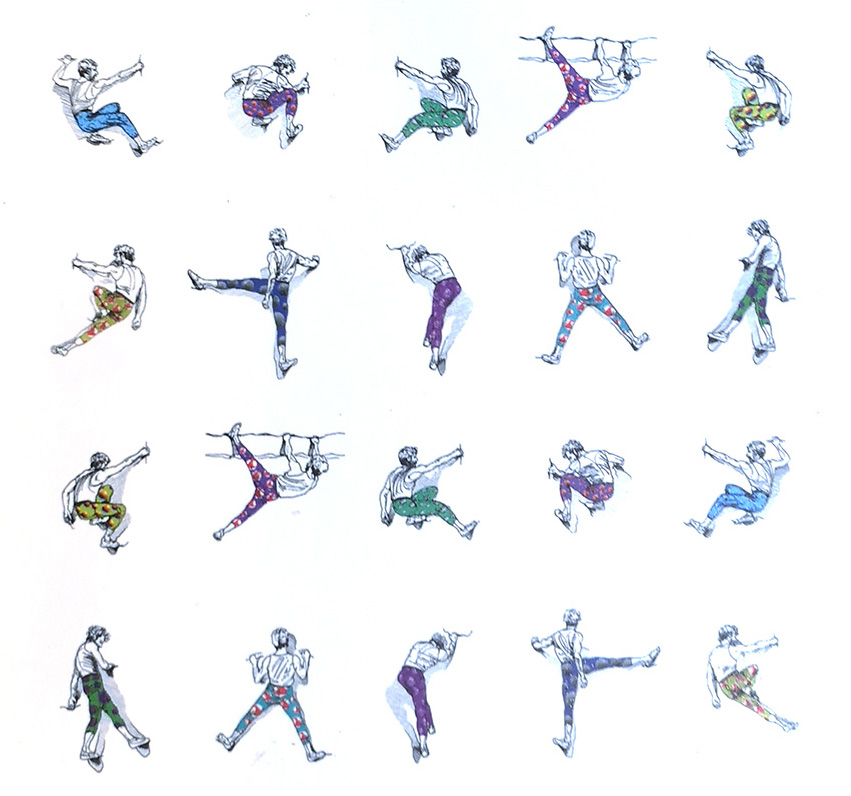

Instinctive Movement and Movement Technique
The misunderstanding arose from confusing innate or “instinctive” motor patterns — such as walking, running, jumping, throwing, or climbing — with the specific movement patterns and technical principles of each sport.
In other words, people failed to distinguish natural movement from the biomechanical study of movement — a process which, through technical and didactic progression, makes it possible to teach and transfer the “ideal” motor skills that define every sport.
People also seemed to forget that a child learns to walk only after a long and difficult process of coordination and motor learning. You might start to run out of instinct, yet running as a sport is something else entirely — it has its own precise techniques. After all, it’s one thing to run at random, and quite another to run well.
The same goes for climbing, which, from a motor standpoint, is far more complex than running or walking.
When it comes to terrain, the level of complexity in climbing and mountaineering is generally higher than in most other sports. If holds and footholds on rock are constantly changing, the same is true for snow slopes, ice, or mountain paths and gullies. Even in tennis — where the surface seems uniform — the angle, length, and speed of each bounce change depending on the type of court.
In every sport, studying different movement situations has helped — not hindered — the identification of both the general and specific principles that govern motion and the use of equipment. This is what makes it possible to define technique.
Technique is the soul of every sport. Why should climbing be any different?
Today that question seems logical — even obvious — but at the time, the belief that climbing couldn’t be taught was so deeply ingrained that my objections seemed to come from another planet.
No one seemed interested in following me down that road, so I realized I would have to continue my research on my own.
The Search for Technique in Climbing: Order in Chaos
That was the beginning of a long period of observation and study. While teaching, I sought to identify the movements that most improved my students, and at the same time, I worked to develop greater awareness of my own movement while climbing.
I soon realized that the more aware I became of my own movement, the more effective I was as a teacher — and vice versa.
Studying the most efficient movements allowed me to recognize the involuntary automatisms that prevent us from moving freely and consciously. It’s essential to distinguish between voluntary and involuntary automatisms. The former are those we acquire through conscious practice — for example, when learning to drive.
The latter are automatisms we’re unaware of, which end up limiting us. These can be physical as well as mental or even cultural. The two are closely related: a mental or cultural automatism can, in fact, prevent us from gaining new knowledge and expanding our motor repertoire.
It took many years before I began to see clear and tangible results — and to identify the first techniques. My in-depth study of Qi Gong, Tai Ji Quan, and Shiatsu — disciplines based on a holistic, natural, and effective approach to the body, breath, and mind — greatly helped me in building the overall framework.
The first step toward bringing order to chaos was to shift attention from the rock to the body itself. It was necessary to start by studying the most objective principles: all human beings have four limbs and a pelvis — where the center of gravity is located — and we all move within a world governed by the same physical laws.
This made it possible to draw general conclusions about how the center of gravity and the limbs can interact and shift in different contexts, particularly in the vertical dimension.
After the initial challenge of identifying the basic principles, the first techniques began to emerge — and then, more and more rapidly, the others followed — with that simplicity typical of discovering a new route: logical, natural, almost inevitable.
The most important technique for vertical climbing, the Progressione Fondamentale (Fundamental Progression), became clearly defined toward the end of the 1980s.
The Bilanciamento (Balancing, or Flag), on the other hand, was developed in 1992 and presented in the first edition of L’Arte di arrampicare (Ed. Mediterranee, 1993).
Before integrating any new technique into the Method, however, I always felt it was essential to test it thoroughly and determine exactly where it belonged within the teaching progression.
It should be emphasized that in the Caruso Metho®, each technique is defined in a precise and distinctive way, starting from its biomechanical principles. At times, the names identifying the techniques may resemble those already in use, but their execution has been completely redefined.


The Caruso Method® Today
The Caruso Method® not a static system. Over the years, it has continued to evolve, deepening its technical, didactic, and cultural dimensions.
Alongside refining climbing techniques, I began applying the principles of vertical movement to ice and soon discovered surprising and fascinating applications of the Method to ski technique — particularly in off-piste and ski mountaineering. These developments filled a gap in understanding the relationship between body movement and ski control on different types of snow.
Eventually, the Matrici del Movimento (Movement Matrices) were born. They represent the fundamental movement patterns of climbing, ice, and skiing, but also of hiking and other motor activities. They came last because it was necessary to have the complete framework in place before grasping and synthesizing the principles that connect everything. Yet they are the first that should be learned, as they form the basis for the most complex and specific movements in rock climbing, ice climbing, and skiing.
Today, the Caruso Method® is a fully developed technical–didactic system for teaching and learning. It enables the best possible development of motor skills in climbing and in all mountain activities.
The Method offers benefits for every practitioner, at every level. By improving the quality of movement, it becomes possible to move more consciously and safely — gaining maximum satisfaction from the sensations and beauty of a natural, effortless motion — or to enhance performance through the effectiveness of its techniques and the precision of motor execution.
The Method as a Didactic System
All the techniques of the Caruso Method® — whether applied to rock climbing, ice climbing, hiking, or skiing — originate from the study of the principles that govern balance and body movement through the shifting of weight and limbs.
Identifying these principles, which lie at the foundation of different motor solutions, also made it possible to define a more precise and effective teaching system. Thanks to the Method, instructors can now convey knowledge that enables students to develop skills far more quickly — abilities that would otherwise take many years of experience to acquire.
To conclude, some have claimed that I didn’t really invent anything, but merely described what already existed. I take that as a genuine compliment!
Discovery is linked to knowledge, to objectivity, to reality; invention is not. Watson and Crick, who discovered the structure of DNA, or Fleming, who discovered penicillin, didn’t invent anything new — yet their discoveries were vital, and they allowed humanity to make a leap forward in understanding.
How much research, study, and consistency are required to discover what already exists! To invent, imagination alone is enough.
The comparison may be bold, but it’s fitting. The Method, after all, rests on scientific and objective foundations; in truth, there is nothing invented or fanciful about it.
The various techniques were not added simply to increase their number, to appear more “modern,” or to follow trends.
In the Caruso Method® every technique has its own purpose, is closely interconnected with the others, and is mutually dependent on them — together forming an organic and complete mosaic of human movement.