The Method on Snow and Ice
Principles of the Caruso Method® on Snow and Ice
The principles that govern movement on snow and ice are fundamentally the same as those applied to rock climbing. The differences mainly concern two aspects:
- ice is generally a more uniform and regular medium than rock and does not allow for friction-based footwork;
- the tools used (crampons and ice axes) usually impose a frontal position to the slope or wall, with the feet placed on the front points of the crampons.
These two factors significantly reduce the range of movements that are otherwise possible on rock. For example, the possibility to use the feet laterally in rock climbing allows for different body positions and, consequently, a wider variety of techniques and progressions.
The main movement patterns applicable to ice climbing are:
- the Progressione Incrociata (Crossed Progression);
- the Progressione fondamentale (Fundamental Progression);
- the Progressione a triangolo (Triangular Progression).

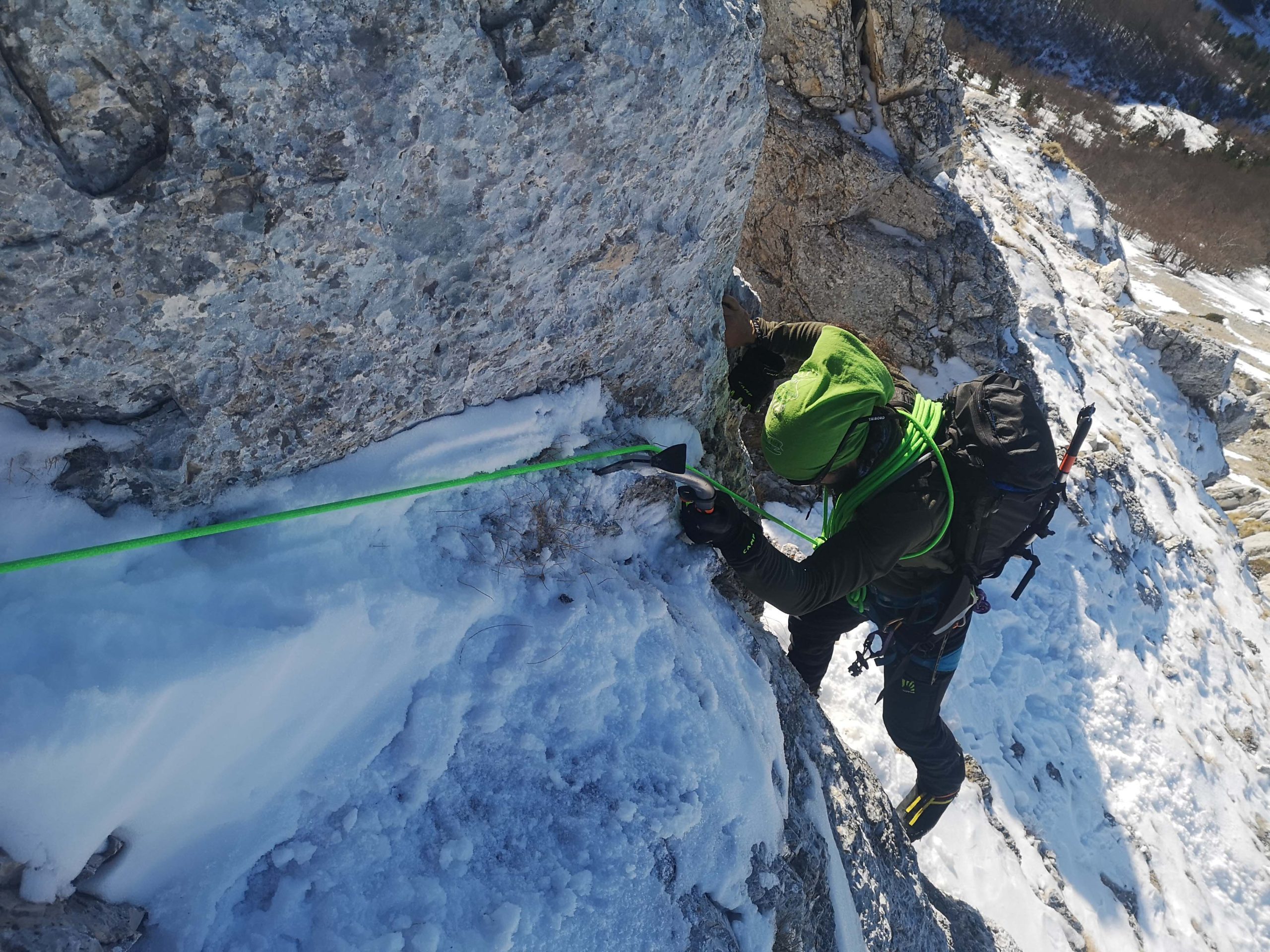
The Importance of the Crossed Movement Pattern
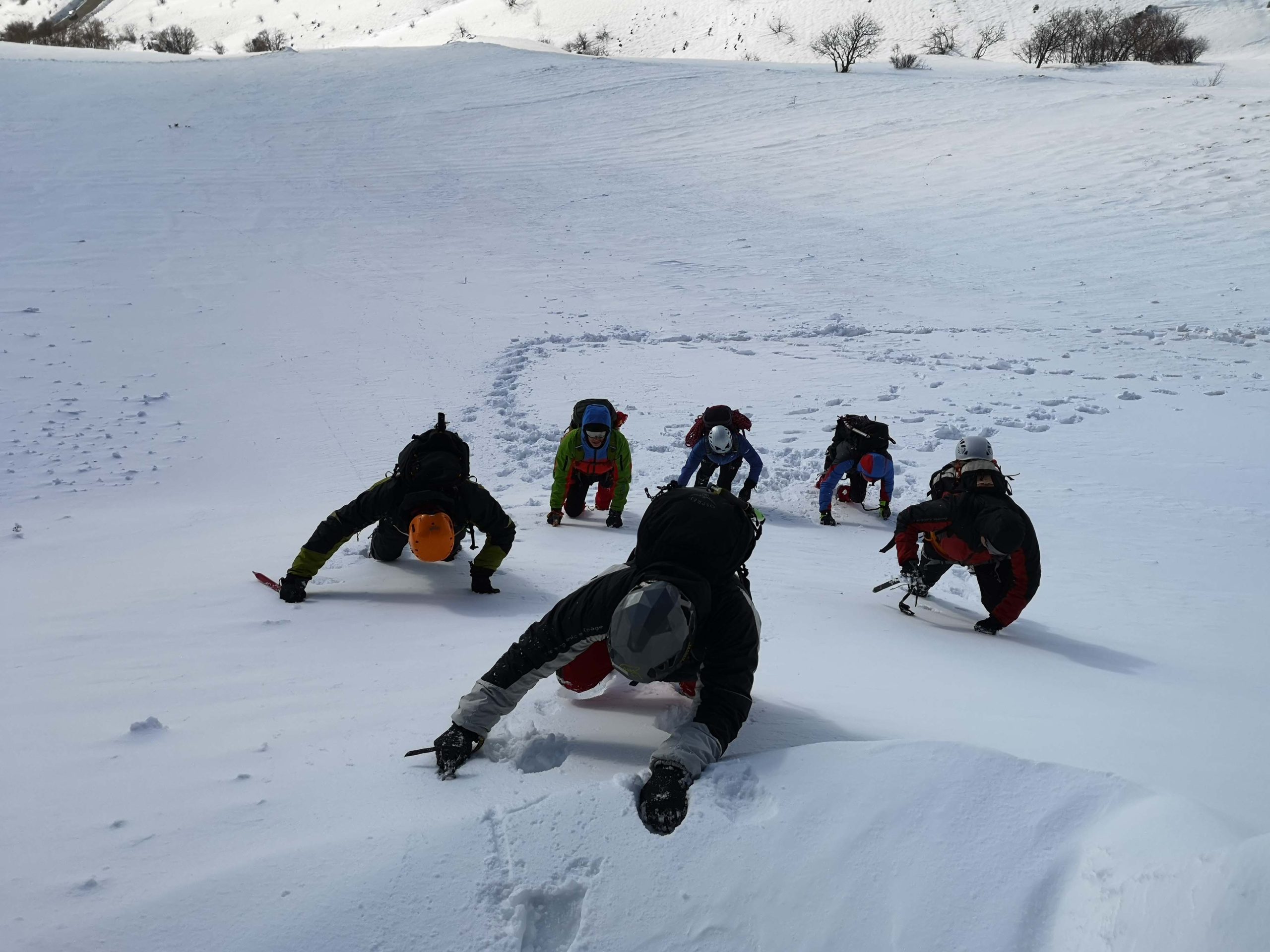
Classic snow slopes provide an ideal terrain for learning and developing a deep understanding of the Crossed movement Pattern—a contralateral movement pattern—whether in its simultaneous, non-simultaneous, or advanced forms. This pattern represents one of the foundations of the Method, both on rock and on ice.
Mastering this pattern already makes it possible to experience first-hand the effectiveness of the Method itself. It allows one to grasp the close relationship between technique and ability, as well as between safety and speed of progression. By practising correct techniques, coordination improves, movement becomes more efficient, and the activity can be genuinely appreciated.
The crossed movement pattern also made it possible to identify the safest and most effective way to move the ice axe on a slope—whether climbing straight upward, traversing, or moving diagonally. Before the development of the Caruso Method®, the Homolateral movement Pattern was predominant, if not the only one known and used. This more primitive pattern is generally less safe and more physically demanding, especially on steep or vertical terrain.
Thanks to an understanding of the Crossed Pattern, it was also possible to develop an innovative Crossed-pattern Shoulder Belay, which replaced the less effective and more dangerous homolateral shoulder belay that is still commonly used today.
Differences from Rock climbing
The Crossed Pattern also provides the foundation for understanding more advanced progressions, particularly the homologous pattern, which is specific to the Fundamental Progression and, above all, the Triangle Progression, which is based on the harmonisation of two movement patterns: homologous and crossed.
When considering these progressions, an important distinction lies in the use of Balanced Positions, which are almost exclusive to rock climbing. The reason is straightforward: on rock, balance is achieved through the friction generated between the rubber of the climbing shoe and the rough surface of the rock. On ice, by contrast, the slippery nature of the medium does not allow for such friction, and attempting to rely on balance can become potentially dangerous. A sound teaching approach must therefore aim to transmit the safest movement patterns, minimising the risk of falls as much as possible. Teaching a technique that is poorly suited to the terrain and potentially hazardous is a serious mistake. Much is often said about safety in abstract terms, but the most important form of safety is that which derives from correct, conscious, and secure movement—something that should always be taught and learned first.
In the early 1990s, when balancing in rock climbing was first introduced (as a way to avoid a split or staggered stance when only one foothold is available and placing both feet at the same height is impossible), it raised considerable doubts. Today, however, since the advantages of balancing in rock climbing (and the disadvantages of the so-called “fifth position”) are well established, reproducing this position on ice—a terrain unsuited to balancing—represents nothing more than a new and incorrect mental automatism. Crampons have front points, not lateral ones, and it is both safer and more effective to place them front-on into the ice to gain an additional point of support. For this reason, the Method introduced a new position: the two-footholds balanced position, which combines the advantages of balance with the security of having two solid points of contact.
Another important difference concerns lateral progression. The front-pointing stance imposed by crampons naturally leads to a frontal body position, bringing the pelvis closer to the wall. This does not mean that alternative solutions are never possible—such as adopting an oblique body position, using a form of balance with one leg free (as can occur in dry tooling), or occasionally using the heel—but these are exceptions and variations that do not represent standard situations in ice climbing.
Technique primarily serves to facilitate the correct execution of the progressions most commonly used. As in rock climbing, once the fundamental techniques have been learned, it becomes easier to combine them and create infinite variations. However, the most demanding and formative phase of learning lies in working deeply on correct and fundamental movement patterns, so that they can be consciously internalised and automated.

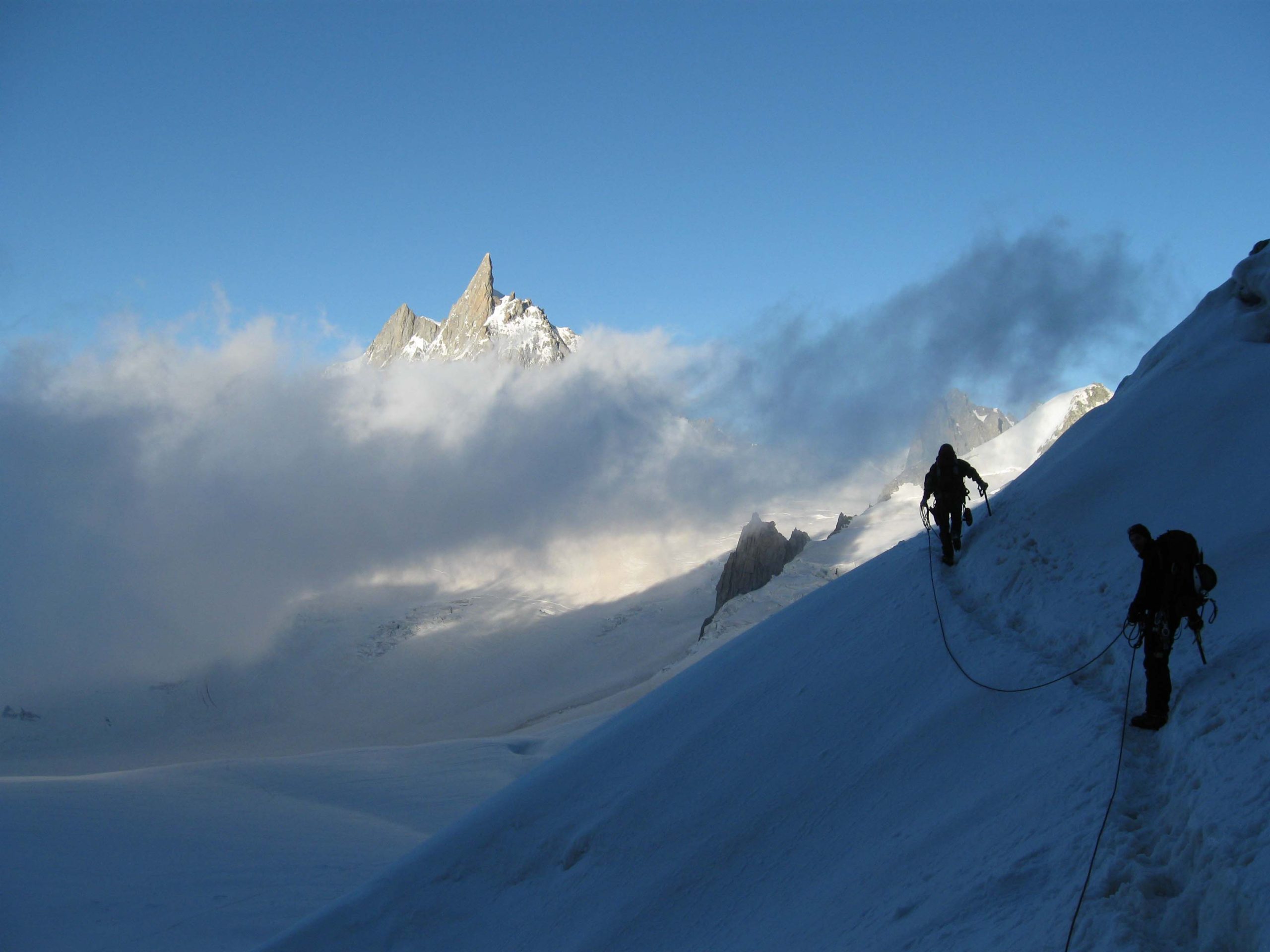
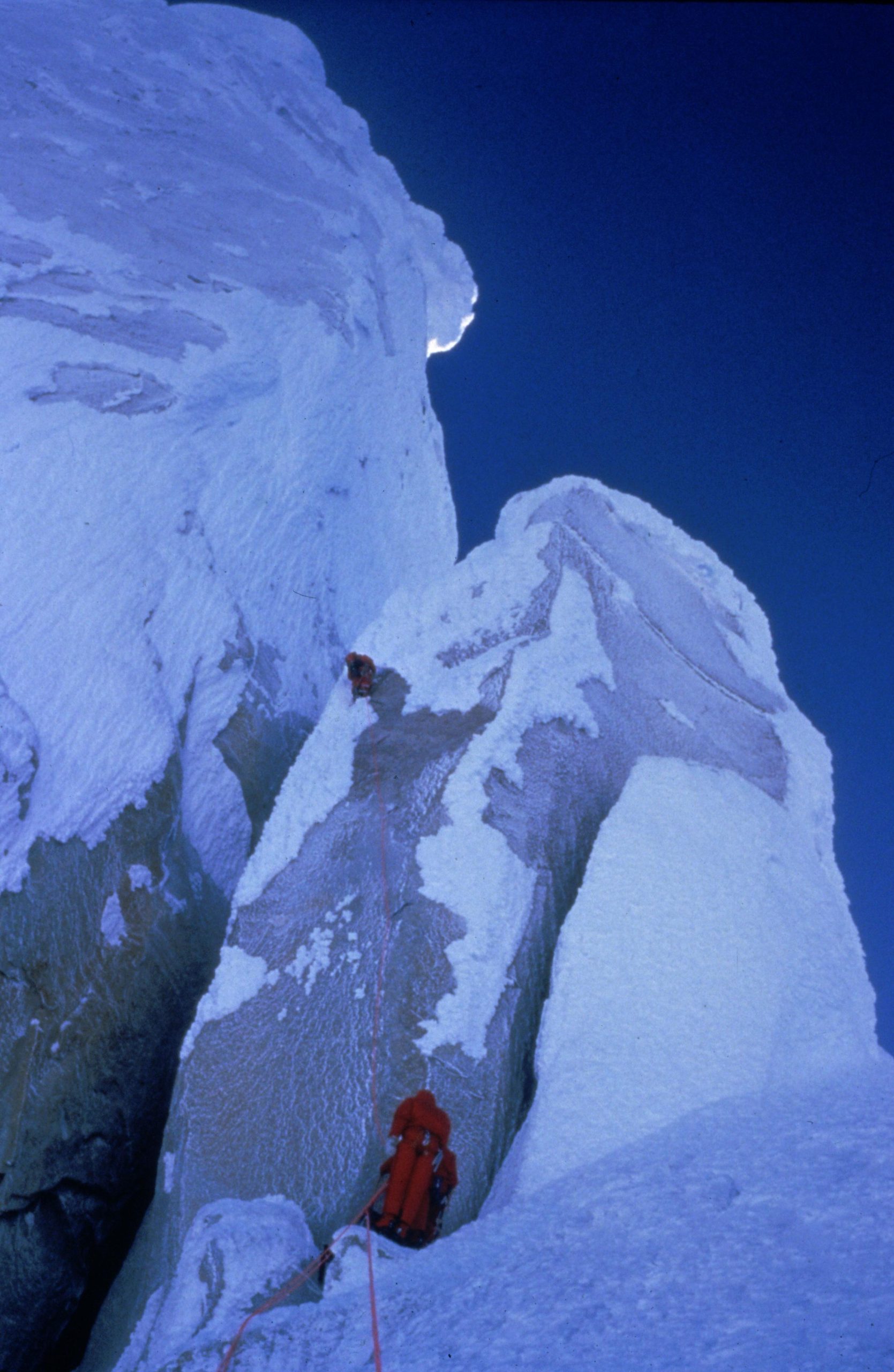
Progressions on Snow and Ice
Apart from the Crossed Progression—simultaneous, non-simultaneous, and advanced—which is mainly applied on classic snow terrain, the most important techniques for icefalls and steeper, more vertical sections can be summarised as follows:
- Progressione fondamentale con 2 appoggi (Fundamental progression – Two footholds)
- Progressione fondamentale con spaccata (Fundamental Progression – Split)
- Progressione fondamentale con sfalsata (Fundamental Progression – Offset footholds)
- Accoppiamento dei piedi (Feet Match)
- Progressione a triangolo con 2 passi con la posizione bilanciata su 2 appoggi, con spaccata e con sfalsata (Triangular Progression – Two Steps with the two-footholds balanced Position, Split and Offset footholds)
- Progressione a triangolo con vertice fisso (Triangular Progression – Fixed Vertex)
- Progressione a Triangolo con vertice fisso e accoppiamento dei piedi (Triangular Progression – Fixed Vertex and Feet Match)
Errors in the Dissemination of the Method’s Ice Techniques
The ice techniques of the Method represent the reference framework for instructors who aim to teach correct movement in ice climbing. Although ice progressions are fewer in number and generally easier to understand than those used in rock climbing, serious errors have nevertheless spread among many instructors as a result of a limited and superficial understanding of the subject.
Beyond the many specific mistakes related to individual techniques, there is often a profound misunderstanding of fundamental concepts—such as pelvic retroversion and anteversion. As a consequence, pelvic retroversion is sometimes incorrectly equated with bringing the pelvis closer to the wall, and anteversion with moving it away from the wall, as occurs during intermediate steps. In reality, anyone with even a basic knowledge of human anatomy knows that these terms refer to the rotation of the pelvis around a transverse axis—that is, to an increase or decrease in lumbar lordosis—something entirely unrelated to the distance of the pelvis from the wall.
When such basic concepts are misunderstood, the more complex motor aspects of movement techniques inevitably remain unclear. For example, it becomes impossible to understand the difference between performing the Progressione a Triangolo (Triangular Progression) with an even or an odd number of steps, or the meaning of the Triangular Progression with a fixed vertex and odd steps. Even the incorrect naming of techniques—which no longer correspond to the original terminology—reveals that certain manuals are nothing more than poorly executed imitations of the Method.
In my view, publishing manuals that contain such serious errors is particularly harmful, as they can mislead many practitioners who are genuinely seeking proper instruction. Experience shows that correcting mistakes requires far more time and effort than learning correctly from the outset. At the same time, however, these poor imitations serve to highlight the validity of the correct techniques: anyone who chooses to return to the source will readily recognise the errors—and therefore avoid them.