The Caruso Method® for Skiing

Ski Mountaineering and Beyond the Piste
When it comes to skiing, while FISI (the Italian Winter Sports Federation) has deepened its understanding of on-piste techniques, much remains to be explored in the realms of ski mountaineering and off-piste skiing.
How should one move on ungroomed snow? And more importantly, what should be taught about how the body moves in different snow conditions? Which exercises and techniques can help skiers learn to manage body weight effectively, so they can guide their skis with precision in every circumstance?
As soon as these questions are asked, the technical and didactic gap becomes immediately apparent. The Caruso Method® has made it possible to take a significant step forward in understanding—and therefore in teaching—the principles that govern precise control of body weight on skis. This is essential not only for the greater safety required in ski mountaineering, but also for developing the ability to adapt to the wide range of situations and snow conditions typical of off-piste skiing.
Until the early 2000s, I believed that skiing movements had little in common with those used in climbing or walking. In reality, this belief was a cultural reflex — as I later came to realise through my work on, and with, the Method. Western rational thinking tends to divide and categorise, leading professionals to specialise within individual disciplines. This approach has its advantages, but it also risks obscuring the bigger picture and the connections that link them.
The development of the Method showed me that an overall vision and specialisation are not opposites. On the contrary, linking aspects that may seem unrelated can lead to new insights and forms of understanding.
By studying how balance and body weight are managed through the specific motor patterns of climbing technique — the Ambio, Crossed, and Homologous patterns — I was able to understand how these same movement schemes could be applied at the precise moment of turning, depending on the type of snow.
Many instructors believe that once you’ve learned proper on-piste technique, off-piste skiing is something you can master on your own — simply through experience. If you’ve read the section How the Method Was Born, this might sound familiar!
In reality, just as in climbing, the body can be made “intelligent” through technique — allowing it to adapt optimally to all situations — the same applies to skiing. Understanding the general principles of movement and the techniques best suited to different snow conditions allows skiers to continuously adapt their skiing style to the ever-changing situations found beyond the piste. These include variations in snow type, slope angle, and even the kind of skis being used. The Method is also designed to maximize both learning efficiency and safety.
The specific motor intelligence developed through the Method leads to a style of skiing that feels natural, harmonious, simple, and effective — eliminating the flaws and errors that limit freedom of movement. Such flaws often arise from involuntary automatisms caused by a partial understanding (and execution) of how the body moves on skis.
The Caruso Method®, when applied to off-piste skiing, is built to enhance each individual’s capacity for movement — rather than to define rigid categories of turns based on their radius or amplitude. As the skier improves, they gain the freedom to choose — and seamlessly execute — whichever type of turn is most appropriate to the circumstances.
Movement Patterns and Balance on Skis
The new approach to off-piste ski technique was born from understanding the relationship between body balance on skis and the three fundamental movement patterns: Ambio, Crossed, and Homologous.
Most common skiing errors stem from a primal tendency to overuse the Ambio pattern. For example, adopting an Ambio stance tends to stiffen the upper body, shifting weight backwards and causing unwanted body rotation. To counter this tendency — as in climbing — we can act directly through the Crossed pattern, which promotes central balance of body weight, the first essential quality of a skilled skier. All other exercises that fail to work on this pattern are less effective for developing true centrality.
The Crossed movement pattern also made it possible to refine, in ski mountaineering, the uphill direction change using the simultaneous crossed inversion, an evolved technique that is crucial for maintaining continuity of motion and rhythm during ascent.
In descent, one of the hardest aspects to grasp — even theoretically, but especially in practice — is that the skis’ response depends not only on how we manage body weight, but also on the consistency of the snow. Without understanding these fundamental principles, it becomes nearly impossible to transition smoothly from hard-packed to powder or wind-crusted snow. Or rather, it’s possible only for those with an exceptionally high level of practice — not a common case.
The Caruso Method®, however, is for everyone, not just specialists. In fact, those who benefit most are often regular skiers who want to make the most of their limited time and achieve the best possible results.
Precise management of body weight in the three positions — centered, forward, and backward — together with the Ambio, Crossed, and Homologous stances, ensures that the skis respond exactly as intended.
The ability to distribute weight between both skis is equally important — a hallmark of a complete skier. For instance, keeping most of the weight on the outer ski, which is essential on icy or steep terrain, becomes a serious disadvantage in deep powder or wind-crusted snow.
A third key ability is adjusting leg width depending on snow type and slope angle. Once these key elements have been learned — through targeted techniques and exercises — the skier enters the most rewarding phase of learning: applying and adapting techniques consciously according to the situation.
As in climbing, this stage of motor awareness is almost impossible to achieve without first understanding and mastering the movement techniques, both theoretically and practically. Of course, anyone who skis frequently can become proficient, but awareness and the ability to teach are another matter. They depend not on how much one practices, but on knowledge and quality.

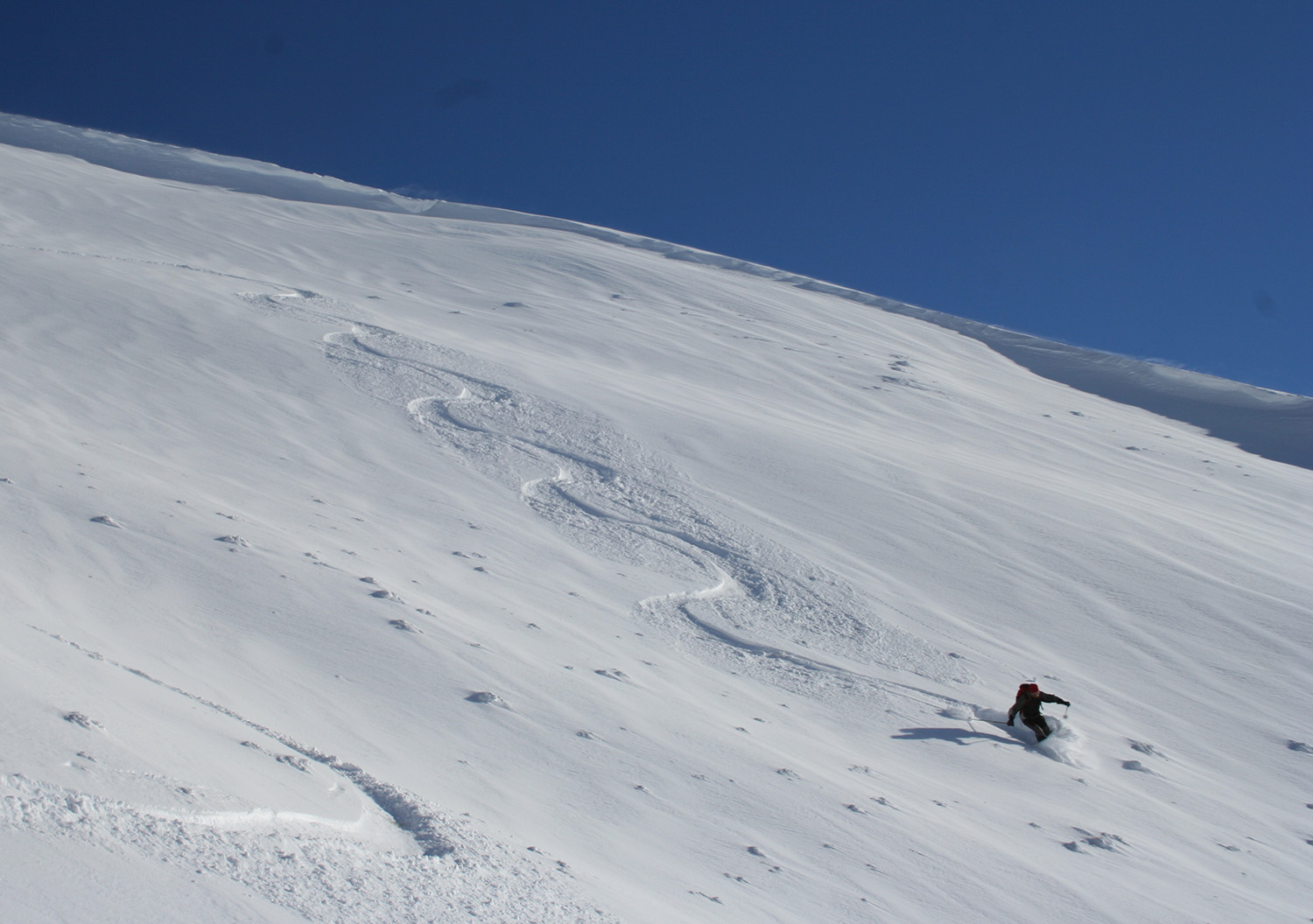

Skiing with Awareness: Perceiving the “Infinite” Movement
If you ask a ski instructor where the body’s weight should be placed when braking in a snowplow, the answer will likely be “in the center” — sometimes “slightly forward.” If you then ask where the weight should be during a parallel turn, the answer is the same: “in the center.” And even in fresh snow, once again: “in the center.” So, one might wonder — is there really no difference between these various techniques and snow conditions?
In reality, while skiing, body weight constantly shifts — both along the longitudinal axis (center–forward–backward) and along the lateral one, with varying distribution between the feet. This creates a continuous rotary movement that traces the symbol of infinity (∞).
In practice, the “center” is not a fixed point but the result of movement — a balance achieved through the constant shifting of weight. Even in soft, powdery snow, the final result is still centered balance, but it’s reached through a different rotational path. That’s why a skilled on-piste skier who tries to manage weight the same way in deep snow initially struggles: the automatism that works on groomed terrain fails off-piste, especially when the skis sink into the snow.
Without knowledge and awareness, the skier can only learn through trial and error — until one day, perhaps, they’ll manage to ski well on ungroomed snow, but without truly understanding how or why. And naturally, no one can teach these differences without first having experienced them consciously. That’s probably why so few courses explain how to adapt one’s skiing technique to different snow conditions.
The same reasoning applies to the snowplow. For many students, the transition from snowplow to parallel turns feels like a true trauma — precisely because they don’t understand why. These two techniques are fundamentally opposite in nature: the snowplow is based on the Ambio pattern, while the parallel turn follows the Crossed pattern, each involving a distinct management of weight and body alignment.
Consciously experiencing the “infinite” (∞) movement means understanding — and embodying — the dynamic nature of how the body moves on skis. It may well be the most important milestone a skier can reach.
Carving or Sliding?
On groomed slopes, carving is usually the ultimate goal. But once you venture beyond the piste, new horizons open up: guiding and gliding become two sides of the same coin — the harmony of opposites in ever-changing conditions.
When skiing off-piste, it’s unthinkable to move the same way on every type of snow. Trying to carve on wind-packed or crusted snow, for instance, means risking a fall at every turn. The mountain teaches adaptability — it’s not wise to stay rigid, either in body or in mind, by insisting on the same pattern. What works in one situation might be entirely wrong in another. The Caruso Method® is designed to develop adaptability — the ability to attune yourself to the mountain’s “demands” and adjust your skiing to the constantly changing character of the snow.
To ski completely, two elements must move in harmony: the body and the skis.
Movement can originate either from the top down — from the body guiding the skis — or from the bottom up, with the feet and skis leading the body. In modern ski instruction, the focus is often on the latter: using the feet to steer the skis, and through them, the body. In contrast, the Caruso Method® begins by teaching how to move through conscious weight shifts of the body, then gradually integrates control from the feet upward. Through this system of techniques, the Method addresses all the components that generate movement, with the ultimate goal of cultivating greater adaptability.
So, what are the key motor elements — the fundamental components of movement on skis? They can be summarised as follows:
- Three weight positions along the longitudinal axis: forward – centered – back
- Three lateral weight positions: right – centred on both skis – left
- Three body configurations: crossed – homologous – alternating
- The ability to widen or narrow stance depending on slope and snow type
- Pelvic–torso isolation, or the ability to separate the movement of the center of mass from the upper body
- Harmonisation of the two centres of gravity
Understanding and coordinating these components gives the skier a holistic view — essential for moving fluidly in any situation. And when compared with climbing, the parallels become evident: right–left and fore–aft weight shifts, limb movement patterns (alternating, crossed, homologous), and finally, the harmonisation of the two centres of gravity — the final piece that completes the mosaic.


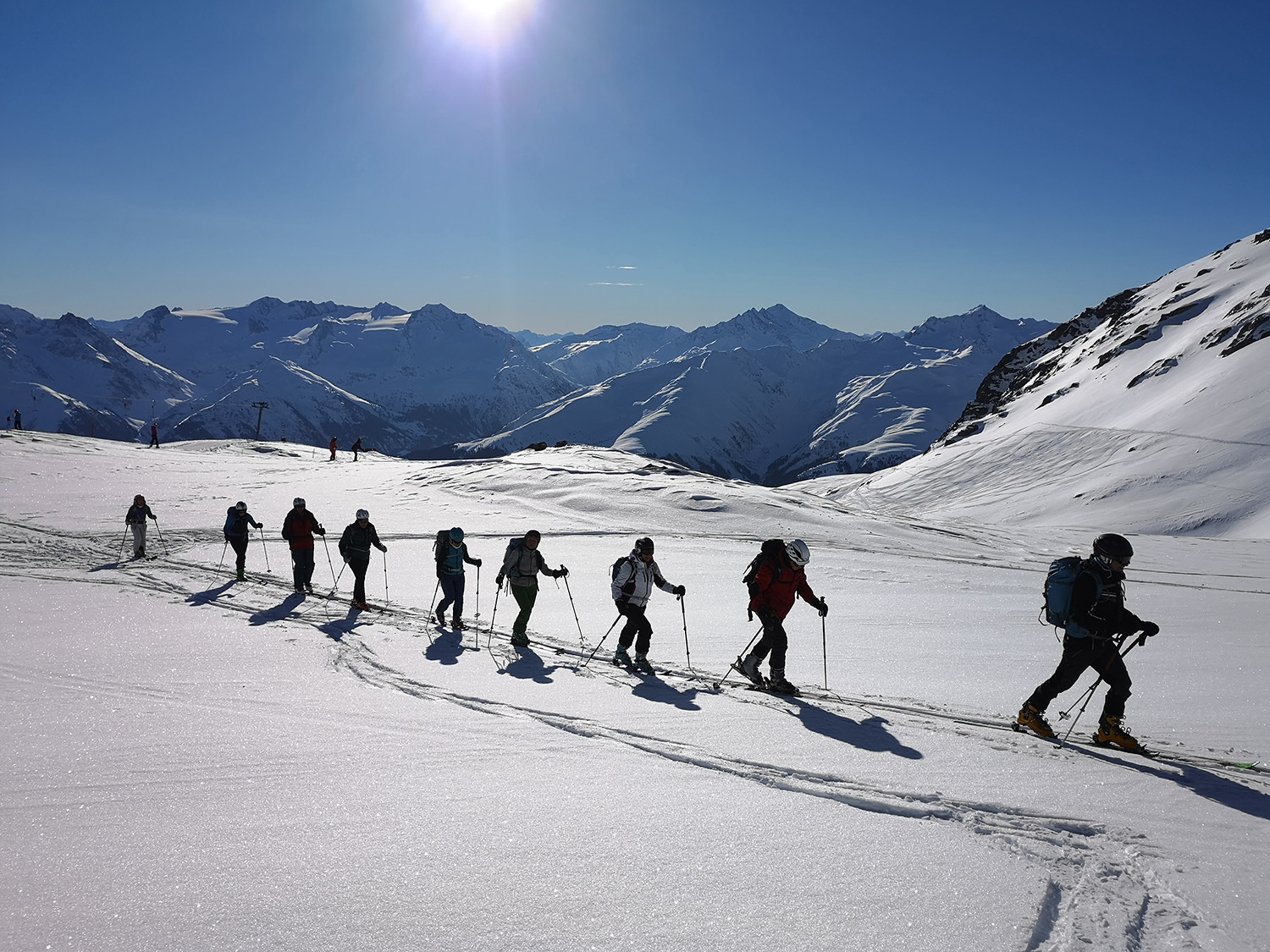

The Caruso Method®: Key Skiing Techniques
At first, it’s best to work on the two directions of movement separately:
From top to bottom: using shifts in body weight to guide the movement of the skis.
From bottom to top: using foot movement to guide the skis.
The Method begins with the first approach — and then integrates the second. The main techniques of the Method applied to skiing include:
- The three weight positions, both in the longitudinal and lateral directions
- The three body configurations
- Pelvic–torso isolation and harmonization of the two centers of gravity
- Same-side (or ipsilateral), crossed, and homologous movement patterns in different situations
- Diagonal sliding to improve ski control and body weight transfer (center, forward, backward)
- The two types of sliding: with skis flat or with edges engaged
- Snowplow: how to manage weight to turn in the smallest possible space and control speed even in difficult conditions — transitioning from the same-side to the crossed pattern (same-side + crossed)
- Substitution with the pole while traversing and from a standstill
- Parallel turns with weight transfer and simultaneous crossed movement
- Parallel turns with full leg extension (apex or “dead point”), "double weighting", and simultaneous crossed movement
- Parallel turns without extension, non-simultaneous crossed movement
- Parallel turns with torso rotation: on moguls and on turns with both skis engaged; jump turns from a standstill on steep terrain.
- Parallel turns using the uphill pole
- Stationary jump turns (simultaneous crossed movement)
- Parallel skiing with perception of the figure 8 or ∞ (infinity)
- “Circle” exercise — preparatory drill for weight management (on powder or compact snow)
- Perception of the reversed figure 8 or ∞ (infinity) in parallel skiing — both on fresh snow and from a standstill with both skis engaged.