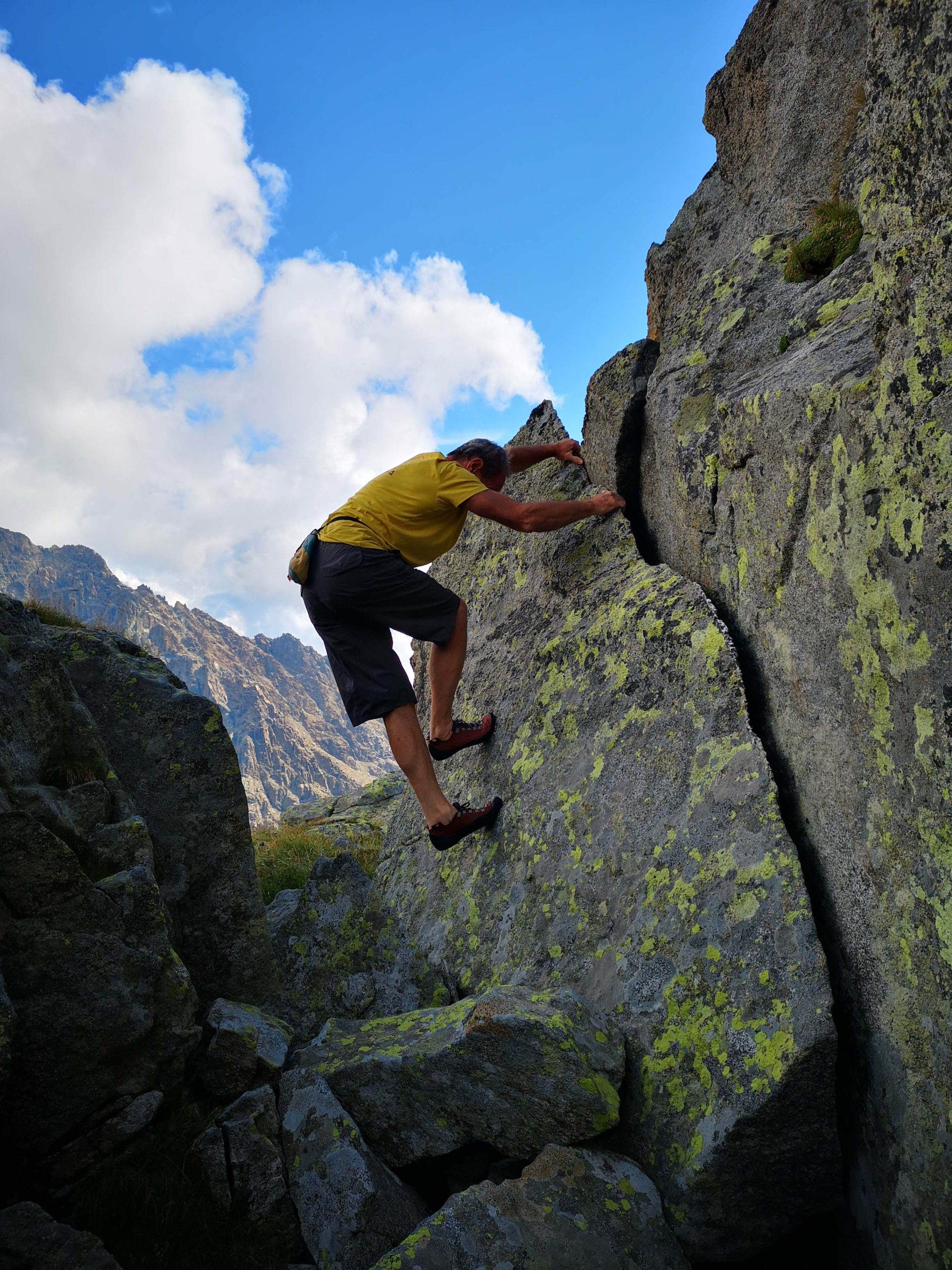
The Method in Rock climbing
From Instinctive Climbing to Technical Understanding
In rock climbing, the Caruso Method® is founded on the principles that underlie ideal movement in the vertical dimension.
These principles have made it possible to define the most effective techniques and progressions for developing capacity and motor intelligence. The Method is based on the understanding that advanced athletes enhance and refine their mental and cognitive faculties by training technique and coordination, whereas beginners often believe that knowledge interferes with so-called instinctive movement — that is, movement driven by random, involuntary automatisms.
In rock climbing — a relatively recent sport — this belief persists. As a result, even today, rock climbing is often taught by passing on sequences of moves used to solve specific problems on specific routes:
“Put your left foot on that hold, now reach up to that crimp, try to pull yourself up...”
Someone once reached the anchors using those moves, and so they’re assumed to be correct. The reasons why, however, remain a mystery. Many climbers move without truly knowing or understanding what they’re doing, often repeating not only effective but also incorrect movements, which over time turn into limiting automatisms. In this approach, the only way to improve one’s motor intelligence is through endless repetition — the so-called “experience.” But not everyone manages to progress technically in this way. For most climbers, tackling harder moves still means relying almost entirely on strength.

Technique and Strength
Being strong and enduring is, of course, a good thing — and at higher levels, it becomes essential. But wasting strength by moving randomly or inefficiently is senseless, and certainly not the mark of a balanced athlete. Optimizing effort, on the other hand, leads directly to improved performance.
Beyond sheer strength, it is clear that skill and ability are even more important. It is well known that, when it comes to performance, in addition to the conditional abilities (strength, endurance, and so on), technical and coordinative skills are the most crucial at every level. These skills form the very foundation of human movement: they develop efficiency, motor intelligence, balance, and psychophysical harmony, while also helping to prevent injuries and maintain overall health.
It is equally important to understand that technical learning must precede the development of strength — or at least progress in parallel with it. After all, the use of strength is instinctive. A very strong person will often struggle to feel the effectiveness of a correct movement unless pushed to their limit.
In the rock climbing world, countless systems exist for training strength and endurance, but when it comes to using and controlling those qualities intelligently, everything is left to chance. And yet, that is precisely the most beautiful, fascinating, and difficult aspect to achieve.
The Caruso Method® is designed to help each practitioner make the best possible use of their resources — regardless of their current training or performance level.
The Techniques of the Caruso Method
The Caruso Method® has identified the fundamental movements — the technical “archetypes” from which infinite variations can arise — by analyzing each one’s strengths, limitations, and effectiveness across different types of terrain (slab, vertical, overhang). Learning these techniques makes the body more intelligent and responsive, enabling climbers to independently choose the most appropriate technique for any given situation, according to their own physical and psychological characteristics — making all the subtle, infinitesimal adjustments required by circumstance.
Although the identified techniques are finite — which is precisely what makes their transmission and teaching possible — it would be a serious mistake to apply them rigidly. It would be just as misguided (and absurd) as thinking that, during a soccer match, one could always kick the ball with the same angle and power as in ideal training conditions, or ski down an irregular slope at a constant speed, with turns of uniform radius and angle. This, however, does not mean that these fundamentals — which are grounded in scientific principles and the laws of physics — do not exist, or that they can be changed or distorted.
Through the Caruso Method® the focus is placed on developing skill, overall capacity, and motor intelligence — facilitating and accelerating learning while avoiding the most common mistakes. In doing so, the most effective movement patterns are acquired, body coordination improves, proper breathing is encouraged, and the ability to manage fear and emotions is strengthened.
Here is the list of the main original techniques in rock climbing:
- Progressione Incrociata simultanea/non simultanea (Simultaneous/non simultaneous cross progression)
- Progressione Incrociata evoluta (Advanced Cross Progression)
- Progressione fondamentale con 2 appoggi (Fundamental progression - Two footholds)
- Progressione fondamentale con bilanciamento (Fundamental progression - Outside Balance)
- Progressione fondamentale con spaccata (Fundamental Progression - Split)
- Progressione fondamentale con sfalsata (Fundamental Progression - Offset footholds)
- Progressione a triangolo con 2 passi (Triangular Progression – Two Steps)
- Progressione a triangolo con 4 passi (Triangular Progression – Four Steps)
- Progressione a triangolo con vertice fisso (Triangular Progression - Fixed Vertex)
- Progressione a triangolo con bilanciamento (Triangular Progression - Outside Balance)
- Progressione laterale (Lateral Progression)
- Progressione laterale eretta (Upright Lateral Progression)
- Progressione laterale con accoppiamento dei piedi (Lateral Progression - Foot Matching)
- Progressione laterale alternata (Alternating Lateral Progression)
- Progressione con tallonaggio (Heel Hook Progression)
- Oscillazione a pendolo (Pendulum Swing)
Complementary Techniques
- Quattro Passi cambio piede (Four-step Foot Switch)
- Sostituzione semplice (Hand-foot substitution)
- Sostituzione mista (Combined Hand-foot substitution)
- Sostituzione inversa (Cross-arm Hand-foot Substitution)
- Sostituzione di gomito (Elbow Press)
- Accoppiamento dei piedi (Feet Match)
- Dülfer/Piaz (con archi omologhi identici) (Dülfer/Piaz (with symmetrical limb arches))
- Bilanciamento Interno ed Esterno: differenze (Inside vs. Back Balance)
- Passaggio Misto (Combined Step)
- Oscillazione ad Arco (Arch Oscillation)
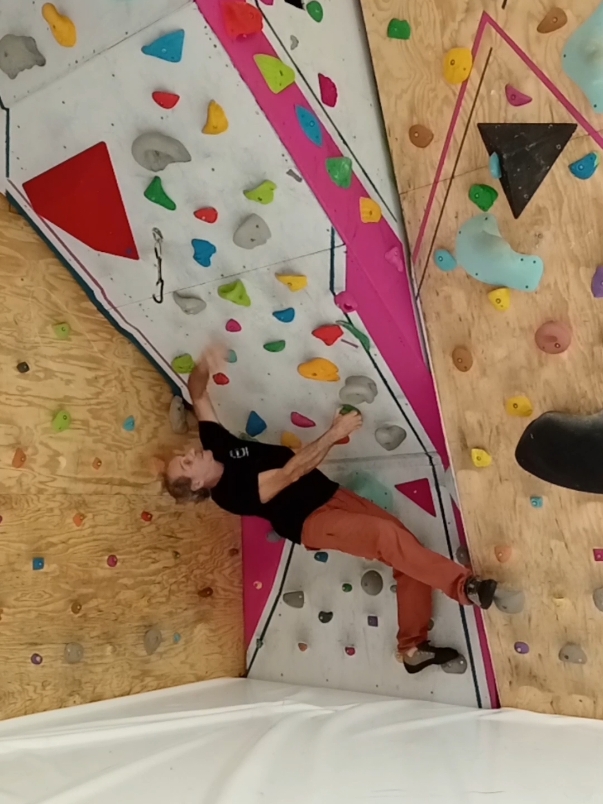

Rock climbing Shoes
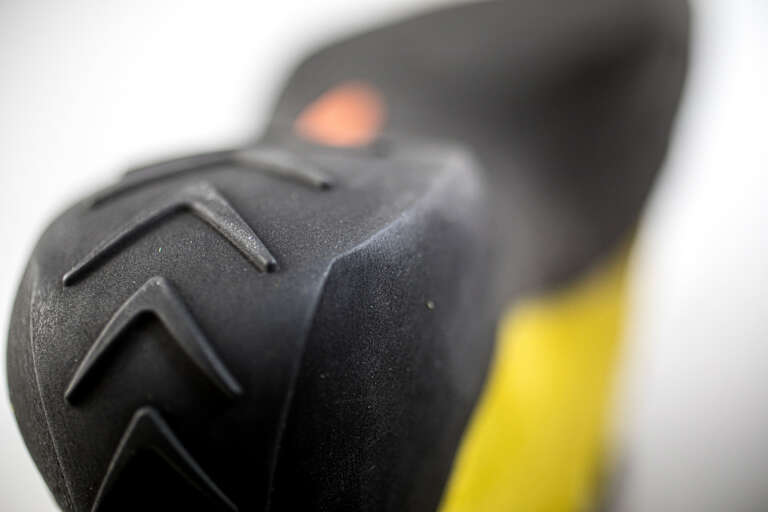
Among all the gear used in rock climbing, shoes are the only ones that directly shape movement — and with it, technique.
When the toes are forced into a cramped position, they deform the foot, cause pain, and restrict natural motion. Likewise, shoes that push the heel into a raised position promote lumbar hyperlordosis and limit pelvic mobility. In other words, the unnatural posture created by some shoes negatively affects how the feet function and how the entire body moves.
For this reason, I set out to design a shoe that would support the most natural movement possible. After years of study and experimentation — and a radical rethink of what a rock climbing shoe can be — the Paradigma was born. Discover them here.